Details
Construction
Dimensions
History
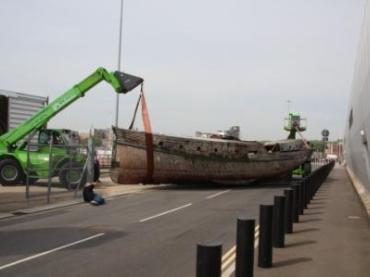
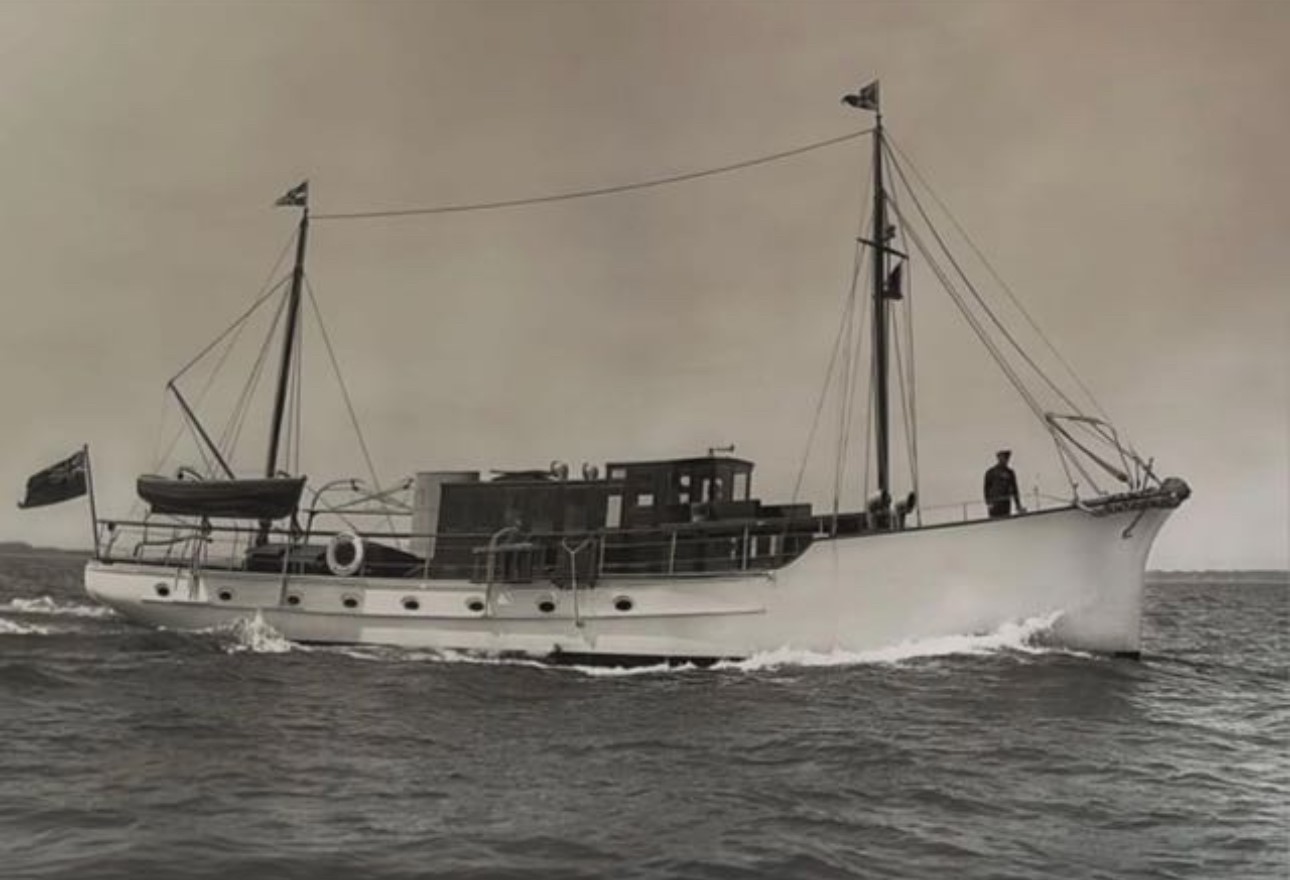
WARRIOR was built in 1912 as a naval pinnace. Her own early records, including her involvement in the evacuation of Dunkirk in 1940, were destroyed when an incendiary bomb struck her while she lay, still under naval command as a coastal defence vessel, on the river Thames at Greenwich.
One important piece of surviving documentary evidence is a substantial illustrated feature published in The Illustrated London News on 27 September 1930 entitled 'Marine Caravanning' which reflects the contemporary importance of large auxiliary motor yachts such as WARRIOR within Britain’s interwar cruising culture and provides rare period commentary on vessels of this exact class and purpose. The article describes these craft as economical, seaworthy and capable of long-distance independent cruising, whilst also highlighting their substantial accommodation, practical engineering and suitability for extended life aboard. The article is especially significant because it demonstrates how vessels such as WARRIOR were viewed during their operational lifetime, not simply retrospectively as surviving heritage craft. It places WARRIOR firmly within the world of serious pre-war cruising yachts associated with affluent and highly skilled owners, long-distance passage making and Britain’s elite motor yachting culture. The publication itself, one of Britain’s leading illustrated newspapers of the period, indicates the wider public fascination with this emerging style of practical motor cruising during the interwar years.
Contemporary documentation confirms that the vessel was requisitioned during the Second World War and dispatched from Chichester towards Ramsgate in company with other small craft including Idaho, FALCON and LETITIA. Surviving wartime logs and correspondence describe severe weather conditions, towing operations and preparations for service off Dunkirk. The vessel’s master, K. S. Brown later wrote that he had “come to like WARRIOR very much and respect her. A good sea boat and no great vices.” Surviving Ministry of Shipping correspondence further confirms that WARRIOR was recognised officially as having participated in the Dunkirk operations and was subsequently transferred to naval control.
Although WARRIOR appears to have arrived during the closing stages of the evacuation, her association with Dunkirk is recognised by both the Association of Dunkirk Little Ships and the historian John de S. Winser. Following Dunkirk, WARRIOR entered Royal Navy service and is listed in the July 1940 Admiralty ‘Red List’ of Minor War Vessels in Home Waters as having been attached to the Auxiliary Patrol Service. The APS was a volunteer force which used private yachts and motorboats to patrol rivers and inshore waters, carrying out vital but unsung work like mine watching or reporting enemy aircraft. Often manned by older volunteers, the APS was a supplement to the main Royal Naval Patrol Service of requisitioned seagoing craft, principally trawlers.
She was later attached to HMS King Alfred at Hove, the principal wartime training establishment for Royal Naval Volunteer Reserve officers. At King Alfred, WARRIOR is understood to have been used, alongside the yachts LEONORA and VACUNA, in navigation and seamanship instruction for newly recruited RNVR officers under the supervision of Lieutenant Commander C. A. Lund, RN. WARRIOR would have been typical of the small, often improvised craft in which RNVR officers would later serve. Lund was still listed as part of the King Alfred establishment in 1945. He was an officer on the ‘Emergency List’, a specific category of older retired officers who were recalled to lead training.
This association is particularly important as it links WARRIOR directly to the wartime mobilisation of civilian sailors and “hostilities only” officers. More than 22,000 officers passed through HMS King Alfred during the war. Most had little or no seagoing experience, beyond perhaps a little weekend yachting. After a scanty ten weeks training, they emerged as the service’s most lowly officers, Temporary Acting Probationary Sub-Lieutenants. Many would go on to command Motor Torpedo Boats in breathless night actions fought at high speed in almost total darkness or drive vital landing craft on to the beaches of Sicily, Salerno or Normandy. WARRIOR thus played a key role in the training and education of what the author Brian Lavery has called the “Citizen Sailors.”
Post-war, WARRIOR had five owners: 1934-37 Captain K B Harbord; 1938-39 W.Louden Douglas; M.C 1949 Flight Lt R. S. Munday A.R.Ae.S; 1950-51 Major C. R . W Brewis, M.C; 1955-65 Wing Commander R. L Bowes D.F.C. Lloyd’s Register entries first record the fitting of RT (Radio Telephone) and ESD (Echo Sounding Device) during the ownership of R. L. Bowes, illustrating the gradual adoption of post-war navigation and communication technologies into private pleasure craft. Stanley Crabtree had her entirely refitted at Dickie's Yard, Bangor, Wales, in the late 1960s. In earlier days she had a fine figurehead of an Indian warrior which was maintained faithfully in its original colours even when WARRIOR was painted in battleship grey. Sadly, she lost this figurehead during her restoration. John and Mary Hornshaw purchased WARRIOR in 1972 from Stanley Crabtree at Glasson Dock, Lancaster, and in May 1973, John and his son Michael and a professional skipper sailed WARRIOR through the Bay of Biscay to Gibraltar.
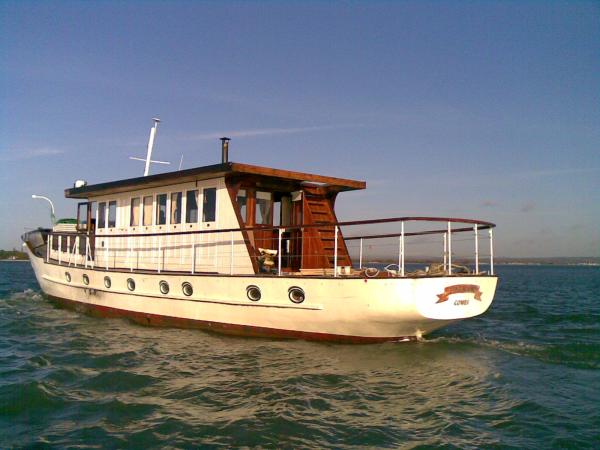
John and Mary lived on WARRIOR in the Mediterranean, exploring from Palma de Mallorca to the Greek Islands, and Malta, and the Spanish mainland coast. In 1985 they brought the vessel back across the Bay of Biscay on their own, and lived onboard in Torquay until selling the vessel in May 1989. She then came under the ownership of Dennis Wells. The vessel’s lower hull was re-planked in 2000 and has had a modern touch with GRP sheathing. The upper helm, despite being rebuilt over the years, retains its original shape. However the saloon behind the helm has changed over the years, from a totally open rear deck to a full saloon. The vessel was sold in 2010 and extensively rebuilt. The present owners then acquired WARRIOR in France in 2022 and returned her to the UK.
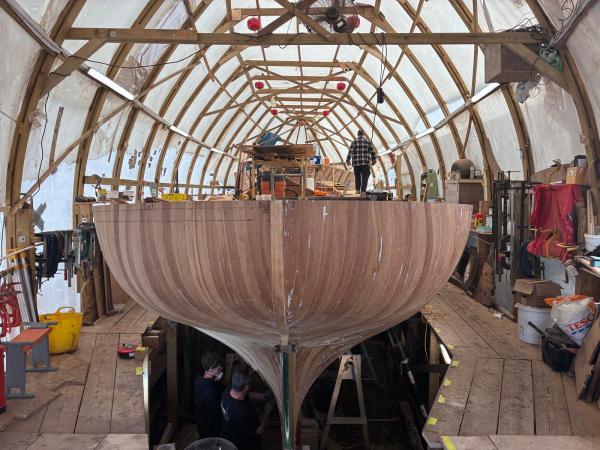
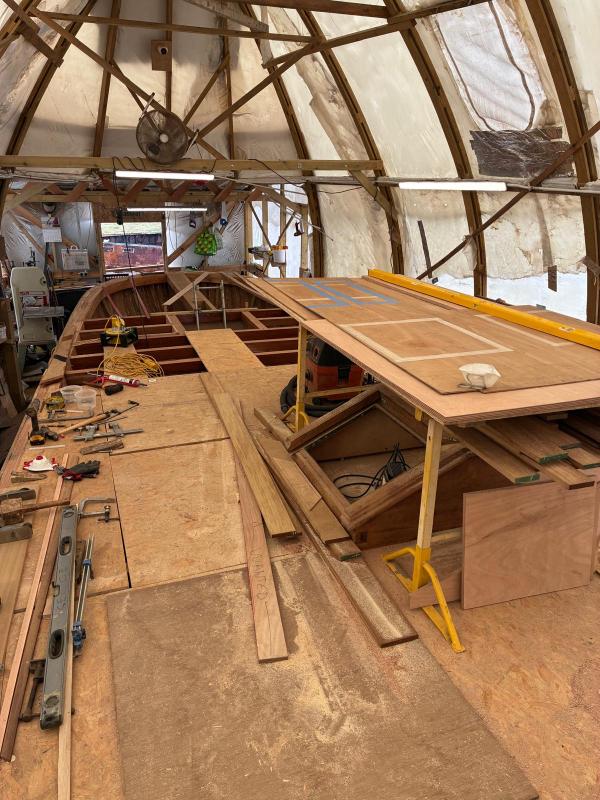
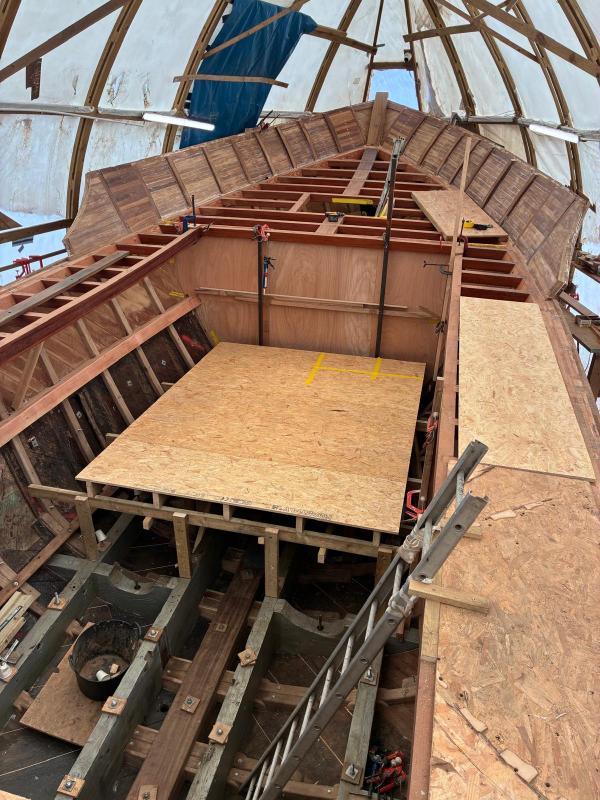
WARRIOR is being restored at Paul Spooner Design on Hayling Island as of November 2024. The owners hope to have work complete in time to take part in the 90th anniversary Return to Dunkirk in May 2030.
Significance
- What is the vessel’s ability to demonstrate history in her physical fabric? Evidence for designs, functions, techniques, processes, styles, customs and habits or uses and associations in relation to events and people. How early, intact or rare these features are may impact on significance.
WARRIOR is an early twentieth-century auxiliary motor yacht of substantial size and quality, originally constructed by Camper & Nicholsons in 1912 as a naval pinnace or Admiralty-associated service craft as evidenced by 'broad arrow' stamped copper clenches used on frames and floors. Although original plans are believed lost, the vessel retains important evidence of both her original construction and her subsequent adaptation through military and civilian service. The hull form remains substantially representative of an early twentieth-century gentleman’s auxiliary motor yacht, retaining the characteristic proportions, sheer and underwater form associated with high-quality pre-First World War design. Surviving elements of heavy timber construction, framing and structural layout continue to demonstrate traditional yacht-building methods of the Edwardian era.
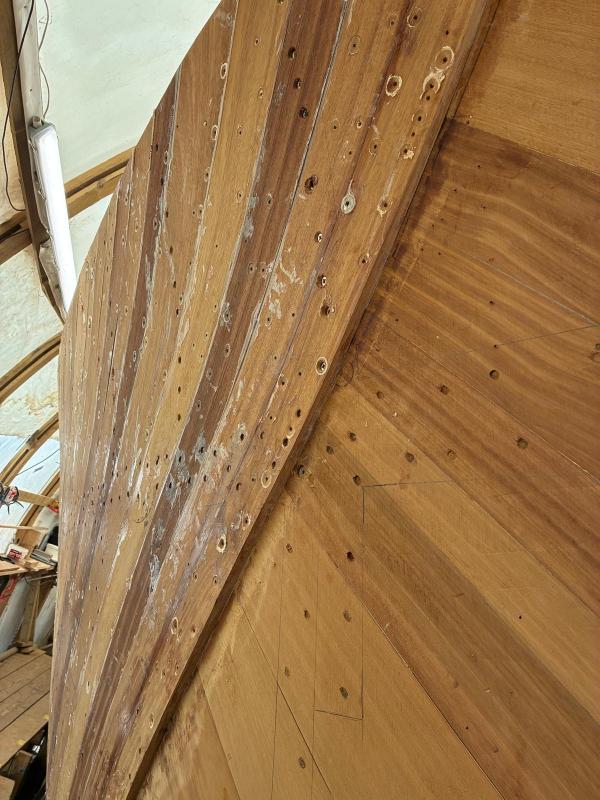
WARRIOR’s fabric also reflects her long and varied operational life with multiple phases of use. Evidence was found which identified earlier fire damage within the stem structure, including burned frames and historic emergency repairs. This supports documentary accounts that WARRIOR suffered incendiary bomb damage whilst in Royal Navy service following Operation Dynamo. Sections removed during conservation have been retained within the vessel archive as evidence of this wartime phase. The vessel also demonstrates the gradual adaptation of a former naval and service craft into a long-term cruising yacht through extensive rebuilding and alterations across successive ownerships.
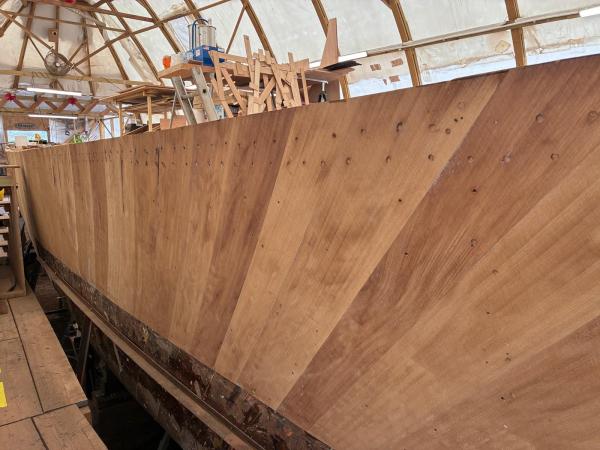
Since 2022, conservation work has aimed to sympathetically return the vessel to operational use in her post-First World War configuration, which also reflects her Second World War service. Surviving historic fabric has been retained wherever practical, whilst replacing failed structural elements using traditional materials and techniques appropriate to the vessel’s age and character. Approximately 80% of the lower hull and keel have survived and a significant number of removable fixtures and fittings, including portholes, deck skylights, and other elements. The 1960 Gardener diesel engines have been removed, stripped and rebuilt and will be reinstalled as part of the reconstruction.
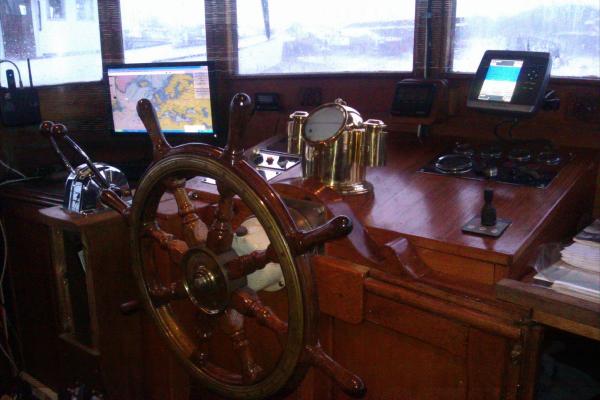
However, the stem, which was rotten and made from several bonded components, has been replaced with a continuous laminated Iroko structure for strength. The upper hull and stern post have also been replaced, along with some forward hull planking, using longer lengths to tie the historic Admiralty launch hull into the new upper sections. The transom and superstructure have been replicated and softwood deck beams replaced with laminated mahogany. A ply sub-deck will be fitted, with reclaimed Burmese teak dating from 1700 used for the upper deck. Ply bulkheads and frames will replace those lost due to rot and continuous upper frames will be installed to tie the historic naval pinnace hull to the upper deck and superstructure. Navigational equipment and a powered windlass were installed during the pleasure craft conversion before the Second World War, and a bow thruster was fitted post war; these will be replaced by modern equivalents as part of the reconstruction. A pair of Seakeeper stabilisers will also be added to prevent rolling and improve safety and comfort at sea.
2. What are the vessel’s associational links for which there is no physical evidence? Associations with people or places. Off-ship research.
The vessel’s earliest association is with Camper & Nicholsons, one of Britain’s most important historic yacht builders. Constructed in 1912 as a naval pinnace or Admiralty-associated service craft, WARRIOR represents the type of small but capable auxiliary craft produced during the years immediately preceding the First World War, when naval expansion and maritime preparedness formed a central part of British national policy. She has important links with Britain’s pre-war yachting culture through the Thames Royal Yacht Club, one of Britain’s leading and most exclusive institutions for motor and steam yachting, associated with the development of long-distance cruising and private auxiliary motor craft during the late nineteenth and early twentieth centuries. Substantial gentleman’s cruising yachts formed an important part of Britain’s maritime social history prior to the Second World War, but comparatively few large pre-war auxiliary motor yachts of this type survive in operational condition. WARRIOR helps illustrate the transition from Edwardian private yachting culture, through wartime naval requisitioning and service, into post-war civilian cruising life.
WARRIOR has international significance from participation in Operation Dynamo, the Dunkirk evacuation of May–June 1940, during the Second World War. Contemporary documentation, including wartime logs and correspondence confirm her role, indicating that she was requisitioned and dispatched from Chichester towards Ramsgate in company with other small craft. Ministry of Shipping correspondence officially recognises WARRIOR as having been at Dunkirk and subsequently transferred to naval control. Although she appears to have arrived during the closing stages of the evacuation, her Dunkirk role is also acknowledged by both the Association of Dunkirk Little Ships and the historian John de S. Winser.
WARRIOR is listed in the July 1940 Admiralty ‘Red List’ of Minor War Vessels in Home Waters as having been attached to the Auxiliary Patrol Service. She later transferred to HMS King Alfred at Hove, the principal wartime training establishment for Royal Naval Volunteer Reserve officers where she was used for navigation and seamanship instruction. This association is particularly important as it ties WARRIOR directly to the wartime mobilisation of civilian sailors and “hostilities only” officers. It also provides an indirect link to her present home in Hayling Island, which formed the Combined Operations base HMS Northney, where landing craft crews were trained prior to the D-Day landings, including officers from Hove.
Post-war, WARRIOR passed through a succession of private owners and became part of the expanding post-war cruising and liveaboard boating culture. The ownership of John and Mary Hornshaw, who sailed the vessel to the Mediterranean where they lived on board her for more than a decade, reflects the growing accessibility of long-distance recreational cruising in the post-war period. WARRIOR is also associated with the history of post-war adaptation and survival of former naval craft. Unlike many comparable vessels which were scrapped or abandoned, she survived through continuous private ownership and practical reuse rather than static museum preservation.
WARRIOR is documented through a substantial body of surviving source material, including: wartime logs and reports; Ministry of Shipping correspondence; ownership records; Lloyd’s Register entries; restoration evidence; photographs; yacht club records; newspaper articles and published historical research. She was recorded on the National Register of Historic Vessels in 2012.
3. How does the vessel’s shape or form combine and contribute to her function? Overall aesthetic impact of the vessel, her lines, material she was built from and her setting. Does she remain in her working environment?
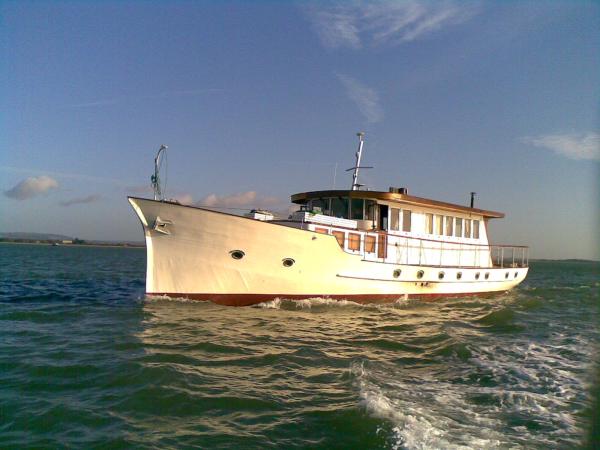
WARRIOR is an aesthetically distinctive and well-proportioned auxiliary motor yacht whose form clearly reflects her original intended function as a seaworthy naval and long-distance service craft capable of extended coastal and offshore operation. Her long sheerline, relatively narrow beam proportions and heavily constructed hull demonstrate the design priorities of early twentieth-century auxiliary motor vessels, combining seaworthiness, economy and practical endurance. Contemporary descriptions and wartime accounts repeatedly refer to the vessel’s capable behaviour at sea, including in adverse weather conditions encountered during the Dunkirk period.
The vessel’s form proved highly adaptable across several distinct phases of service. Originally designed as a naval pinnace or Admiralty-associated vessel, WARRIOR later fulfilled wartime patrol and training functions before evolving into a substantial cruising yacht and liveaboard vessel during the post-war era. Physical modifications undertaken over time reflect these changing operational roles, including navigation equipment upgrades, accommodation changes and later cruising adaptations. The vessel’s proportions, accommodation layout and cruising characteristics are also representative of the type of substantial auxiliary motor yacht associated with institutions such as the Thames Royal Yacht Club during the interwar period. WARRIOR therefore reflects both the technical and social history of British motor yachting during the early twentieth century.
Despite extensive alterations over her long life, WARRIOR retains the essential visual characteristics of a traditional British auxiliary motor yacht of the Edwardian period. Her timber construction, sweeping profile and substantial displacement continue to convey both practicality and elegance. The vessel remains visually representative of a now-rare class of pre-war motor yacht which once formed an important part of Britain’s maritime landscape.
The vessel is undergoing a meticulous reconstruction to return her to operational use. Whilst these works are undertaken, she is ashore and under cover in Hayling Island, close to her area of operation during the Second World War, and accessible to the public by appointment.
Source: Nick Hewitt, May 2026
Key dates
- 1912 Vessel built by Camper & Nicholsons
- 1940 Vessel involved in the evacuation of Dunkirk during the Second World War
- 1942 Vessel served as a coastal defence vessel used to instruct naval officers at HMS KING ALFRED
-
Late 1960s
Underwent entire refit at Dickie's Yard, Bangor, Wales
- 1973 Sailed through the Bay of Biscay to Gibraltar
- 1985 Vessel returned from Bay of Biscay to Torquay
-
2012
Vessel's centenary year
Own this vessel?
If you are the owner of this vessel and would like to provide more details or updated information, please contact info@nationalhistoricships.org.uk
More like this
National Historic Fleet, built 1911 by White, J Samuel & Co Ltd, Cowes, Isle of Wight
Registered, built 1885 by Unknown
National Historic Fleet, built 1912 by Admiralty, Sheerness