Previous names
- RTTL 2757
Details
Construction
Dimensions
History
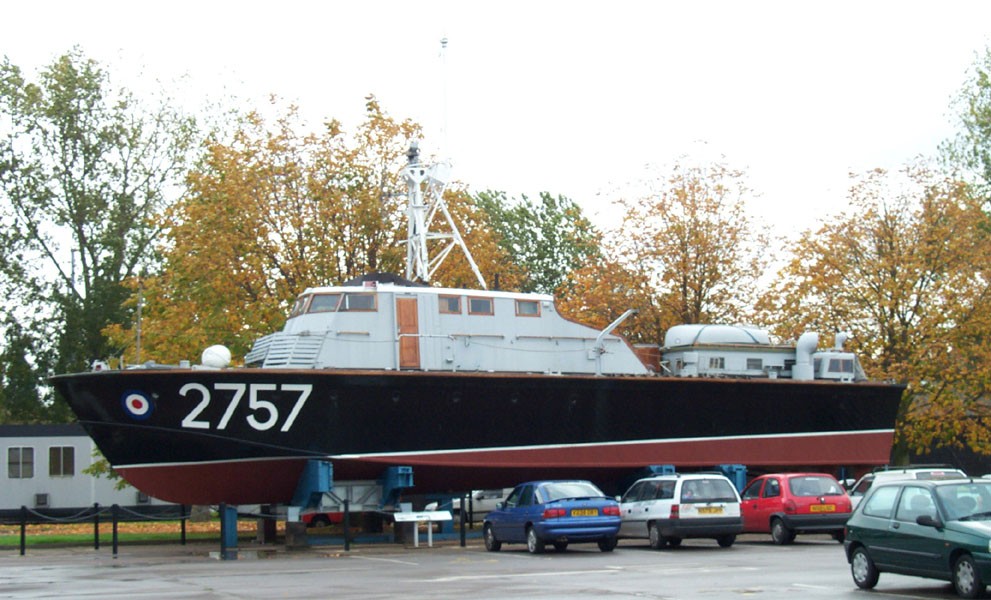
Built in 1957 by Vospers, Southampton, this was the second vessel constructed to a refined design and upgraded engines as a Mark II RTTL. These craft were the flagships of the RAF fleet from the mid 1950s to the early 1970s with 21 examples deployed worldwide. 2757 was powered by twin turbocharged Rolls Royce “Griffon” engines which were 16 and a half litre V12 petrol engines using 130 Octane Avgas highly leaded petrol. These were the same engines as used in the Shackleton Maritime Patrol aircraft except that the marine version had a water jacket fitted for cooling. Each engine developed 1750 BHP and they were configured to run through a “V” drive to the propellers, i.e. the back of the engine faced forward. HMAFV 2757 was involved in important trials to enable the launches to rise more effectively on to the plane. The Mark II RTTL tended to a bow-high attitude in the water and, as a result, the deep vee section at the forefoot rode above the water rather than cutting into it to soften and divide the water as it should to maximise the speed gained from the planning effect. A fixed angle trimming wedge was fitted under the rear hull, which helped the launch to rise onto the plane more effectively. The wedge is visible on 2757 in her current location at the RAF Museum’s London site.
Her official RAF Movement Card shows that, following delivery to No.238 Maintenance Unit in January 1958, HMAFV 2757 was assigned to No. 1100 Marine Craft Unit (MCU) in Alness until August 1965, when she returned to Mountbatten (Plymouth) for Category 4 Repairs. On completion of that work, some 6 months later, she was assigned to No.1105 MCU Portrush, staying there until the unit closed in 1971. On 18 June 1971, while at Mountbatten, she was ordered to sea to search an area west of Plymouth where gigs and whalers taking part in the annual Royal Navy Regatta had got into trouble in rough seas with a Force 7-8 winds. By the time she rounded Rame Head, the wind speed had risen to a full south-westerly gale and she was beaten back to Plymouth. She was again called on to support the rescue effort for the same event in a Force 8 gale. In 1974-5, the vessel was regularly commanded by F/Lt Colin Chandler, completing some 50 operational exercises/sorties, mainly involving RAF aircraft, though with some work with the Royal Navy and Army. She was latterly kept serviceable at RAF Mountbatten pending being gifted to RAFM as the last surviving 68ft H.S.L. in the UK.
On 26 November 1977, she made her final voyage from RAF Mountbatten up the English Channel to London's Royal Victoria Docks (arriving on 28 November) for movement by road to Hendon where she became a museum exhibit on 4 December 1977. After 25 years in one position at the end of the Museum car park, she was moved across the car park to her present display position by crane and lorry on 15 August 2002 to make way for the new landmark ‘Milestones’ building. She continues to be restored and maintained by volunteers, a friends team and contractors, with a partial re-paint completed in November 2003.
Significance
- What is the vessel’s ability to demonstrate history in her physical fabric? Evidence for designs, functions, techniques, processes, styles, customs and habits or uses and associations in relation to events and people. How early, intact or rare these features are may impact on significance.
HMAFV 2757, a Mark 2 RTTL, was built by Vospers of Southampton in 1957 as the second vessel constructed to a refined design with upgraded engines. The Rescue and Target Towing Launches (RTTL)’s pioneering design features were developed before the Second World War and exemplified by the RAF’s wartime High Speed Launches (HSL). 2757 was used for trials of a design modification for improved performance that was subsequently adopted fleet wide. This involved fitting a fixed angle trimming wedge under the rear hull, which is still visible today. The hard chine design was also taken forwards by the RNLI in post war lifeboat design, notably the Arun class lifeboats. HMAFV 2757 remains highly original, other than re-decking in late 2007 and some minor repairs, which include her trial modifications. All the internal fixtures, deck fittings, mast and communications rig survive intact from her service life. Stanchions have been fitted for health and safety purposes which could be removed for later display. Unlike other survivors of this type, she was not converted for civilian use and retains her full inventory of equipment, including mast and radar scanner from her de-commissioning. The wheelhouse, galley space, crew accommodation and master’s cabin are all unaltered while the instruments, compass bowl, controls and radio remain in place. Her metal superstructure is intact and unchanged. Mark 2 RTTLs were powered by twin turbocharged Rolls Royce “Griffon” engines which were sixteen and a half litre V12 petrol engines using 130 Octane Avgas highly leaded petrol. These were the same engines as used in the Shackleton Maritime Patrol aircraft and final versions of the Spitfire, except that the marine version had a water jacket fitted for cooling. Both engines have been retained in storage at the RAF Museum.
2. What are the vessel’s associational links for which there is no physical evidence? Associations with people or places. Off-ship research.
RTTLs were the flagships of the Royal Air Force fleet from the mid-1950s to the early 1970s. Their ‘hard chine’ design followed principles developed by Hubert Scott-Paine and T E Lawrence (Lawrence of Arabia) in the 1920s both for the rescue of flying boat crews and the support of record-breaking seaplane flights in the Schneider Trophy air races. Initially procured for rescue at sea and the towing of targets for air to surface gunnery and bombing practice, RTTLs assumed varied roles in locations as far afield as the Middle East, Far East and Indo-Pacific regions. HMAFV 2757 was assigned first to No.1100 Marine Craft Unit (MCU) in Alness and later to No.1105 MCU Portrush, where she remained until the unit closed in 1971. During this time, she was involved in target towing, torpedo and sonobuoy recovery in support of the Nimrod Maritime Patrol Aircraft operating from RAF Kinloss. 2757 provided a winching platform for the helicopters at RAF Lossiemouth and supported them in Search and Rescue tasks. She also boarded and searched merchant vessels for contraband and weapons off the coast of Northern Ireland and undertook joint maritime courses around the Northern Isles, simulating a Soviet missile platform and attacking a NATO fleet at night. In 1977 she was allocated to the RAF Museum at Hendon for permanent display as the last surviving 68ft H.S.L. in the UK. HMAFV 2757 was recorded on the National Register of Historic Vessels in 1996. Archive material relating to her service record and maintenance documents is held by the Air Sea Rescue and Marine Craft Section Club while some personal recollections of service on board have been published in the Club's journal 'Webfoot'.
3. How does the vessel’s shape or form combine and contribute to her function? Overall aesthetic impact of the vessel, her lines, material she was built from and her setting. Does she remain in her working environment?
The RTTL retains the form of the wartime ‘Hants and Dorset’ High Speed Launch and is built from the same materials, principally mahogany and teak. The double diagonal hull construction conferred strength and enabled increased capacity, comfort and endurance, all of which became essential as the speed and duration of seaplanes and flying boats increased in the inter war period, covering rescues at some distance from shore until the availability of helicopters with sufficient range. The hard chine design enabled the bows of the craft to rise out of the water to reach impressive speeds and was a key feature of wartime HSLs deployed to rescue downed aircrew from the sea. Aesthetically, HMAFV 2757 displays the same sleek lines that gained the HSLs the affection of their crews and those whom they rescued from almost certain death at sea. HMAFV 2757 is on display out of the water in the RAF Museum car park. Whilst removed from her working environment, she is preserved alongside the aircraft and other artefacts that represent her function and roles. The contribution of marine craft to national history is reflected by association with the deeds and operations that she supported in a national museum of international standing.
Author/Date: Nick Morris, RAF Museum, July 2026
Sources
Brouwer, Norman J, International Register of Historic Ships, Anthony Nelson, Edition 2, 1993
Own this vessel?
If you are the owner of this vessel and would like to provide more details or updated information, please contact info@nationalhistoricships.org.uk
More like this
Registered, built 1943 by White, J Samuel & Co Ltd, Cowes, Isle of Wight
Registered, built 1942 by Philip & Sons, Dartmouth
Registered, built 1956 by Robertsons, Dunoon